Realm review: is it worth it in 2026?
By Sankalp Jonna · Last reviewed April 2026
Realm by ACS Technologies
Mature, accounting-grade ChMS from a legacy vendor, strongest for churches that need real general ledger.
Visit Realm by ACS Technologies ↗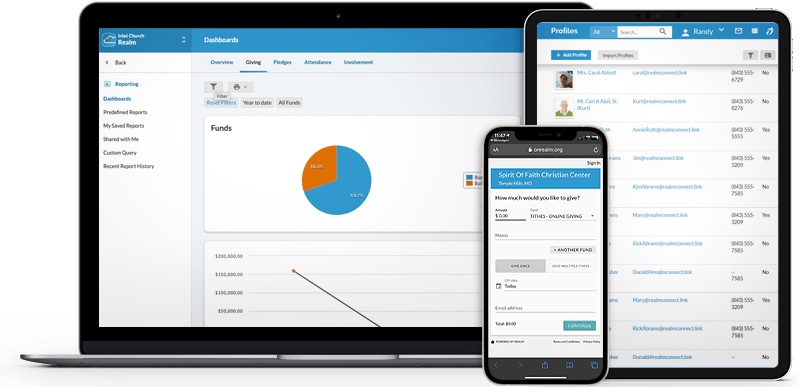
Realm is the church management system you choose because your finance team won the procurement conversation. ACS Technologies has been doing this for 40-plus years, and Realm is the only mainstream ChMS where fund accounting is real general-ledger software living inside the same product as your member database, not a giving report, not a QuickBooks export, but actual GL.²
That single feature is the reason Realm wins deals at established churches and denominational offices. It's also the reason Realm is rarely the trendier pick. The interface looks like a 2018 enterprise SaaS app, the onboarding takes weeks, and the mobile experience trails Subsplash and Pushpay.⁴ We respect what Realm is, a serious tool for serious finance teams, and we won't pretend it's something it isn't.
What it is
Realm is the cloud-based ChMS product from ACS Technologies, a Florence, South Carolina company that has built church and denominational software since 1978.² ACS Technologies has multiple older products (ACS, PDS, HeadMaster) and Realm is the modern flagship, launched in 2014 to bring the company's accounting and member-management heritage onto a web platform.²
The product comes in three tiers that escalate by capability. Realm Inform is a stripped-down membership and giving plan for very small churches. Realm Connect is the mid-tier, adding groups, events, communication, attendance, and pathways (discipleship tracking). Realm Accounting is the top tier and the reason most buyers are here, it adds full fund accounting, accounts payable, accounts receivable, and payroll to the same environment as the member database.³
What Realm does well is what older church software companies have always done well: handle the operational complexity of established mid-to-large churches and denominational structures. Multi-site permissions are mature. Cross-campus reporting works. Background-check integration with Protect My Ministry is built in. Pathways genuinely lets you build and track discipleship tracks. The pieces fit together because ACS has been building them for decades.
What Realm does not do well is feel modern. The UI is functional, not delightful. The mobile app is competent but lags. Self-serve onboarding is essentially not a thing — most implementations require paid setup services and several weeks of work, especially for the accounting module. Reporting beyond the built-in templates can require ACS support to customize, which adds friction.
Who it’s for
Realm is for mid-to-large churches and denominational offices who want a single vendor for membership and full fund accounting. The classic buyer is a 600-2,500-person Methodist, Presbyterian, Lutheran, or Catholic church with a real finance committee, a part-time bookkeeper, and a culture that values continuity and durability over the latest UX trends. Smaller denominationally affiliated churches that need to report up to a regional body also fit well.
It's not the right pick for churches under 200 people, churches whose primary worship culture is contemporary with a heavy band rotation (Planning Center will dominate), or churches whose staff is younger and used to modern SaaS interfaces. We'd also push back on Realm if your finance team is happy running QuickBooks separately — at that point, you're paying for an accounting module that duplicates what you already trust, which doesn't pencil out.
Key features
Genuine general-ledger software with funds, AP, AR, and payroll baked into the ChMS. The single most important reason to choose Realm over Planning Center, Breeze, or Pushpay.
Build multi-step discipleship tracks (new member, baptism, leadership pipeline) and track members through them. One of the few ChMS products that takes this seriously.
Mature, battle-tested cross-campus permissions and reporting. Realm has been used at multi-site denominational churches long enough that the data model handles real complexity.
Protect My Ministry integration is built in for child-volunteer workflows, with renewal tracking and compliance reporting. Common at churches with real risk-management oversight.
Online giving runs on Vanco at roughly 2.55-2.95% on cards. Vanco is the older, more conservative giving processor; rates are higher than Tithe.ly or Planning Center Giving but the integration is tight.
Not optional for the accounting module. Realm onboarding involves paid services and typically takes weeks for accounting setup. This is normal for the buyer profile but a real barrier if you expected self-serve.
Forty-plus years in the category. Whatever else you say about Realm, the company isn't going anywhere and your data isn't going to get orphaned by a sudden pivot or acquisition.
Pros & cons
- Built-in fund accounting is genuinely real general-ledger software, not a giving report — rare in the ChMS world.
- Pathways feature lets you build discipleship tracks and actually track members through them.
- Multi-site permissions and cross-campus reporting are mature and battle-tested.
- Background-check integration with Protect My Ministry is built-in for child-volunteer workflows.
- ACS has been doing this for 40+ years; the company won't disappear and your data won't get orphaned.
- UI feels dated compared to Planning Center or Breeze — it's functional, not delightful.
- Implementation usually requires paid onboarding and can take weeks for accounting setup.
- Pricing is quote-based with multi-year contracts; not friendly to month-to-month evaluation.
- Mobile app is competent but lags behind Subsplash or Pushpay for member experience.
- Customizing reports beyond the built-in templates can require ACS support, which adds friction.
Pricing
Realm pricing is quote-based and tiered by product.¹ From church reports and third-party reviews, Realm Inform lands around $50/month for very small churches, Realm Connect is roughly $90-150/month for mid-size churches, and Realm Accounting adds another $200+/month on top of Connect.⁴ Multi-site and larger churches typically pay $400-700/month for the full stack. Vanco giving fees are separate at roughly 2.55-2.95% on cards.
Contracts are typically annual and not friendly to month-to-month evaluation. Implementation services are an additional one-time cost, often $1,500-5,000 depending on the modules and the data migration scope. The pricing isn't unreasonable for what you get — fund accounting alone would be a meaningful line item elsewhere — but the lack of a self-serve evaluation path means most buyers commit before they fully see the product, which is a real ask.
| Plan | Price | Includes |
|---|---|---|
| Realm Inform | Contact sales | Membership and giving for very small churches; quote-based, typically ~$50/mo. |
| Realm Connect | Contact sales | Full ChMS with groups, events, communication; quote-based, often $90-150/mo. |
| Realm Accounting | Contact sales | Adds fund accounting, payroll, AP/AR; quote-based, often $200+ on top of Connect. |
Transaction fees: Around 2.55-2.95% on Vanco-powered giving
Alternatives
The modular industry standard for service planning, volunteer scheduling, and people management.
Quietly capable, low-cost ChMS with built-in accounting that punches well above its price.
Legacy enterprise ChMS with a newer F1Go cloud product, still common at large institutional churches.
Verdict
We'd recommend Realm for established mid-to-large churches and denominations whose finance team is the most influential stakeholder in the ChMS decision. The accounting module is a legitimate reason to pick Realm over Planning Center plus QuickBooks — once you factor in the time saved by not reconciling between two systems, the math often works out. For Methodist, Presbyterian, Lutheran, and Catholic churches with real reporting obligations to a denominational body, this is a strong, durable, slightly conservative choice.
Skip Realm if you want a modern UI, self-serve onboarding, or you're already happy running QuickBooks separately. Skip it if your church culture leans contemporary and your worship pastor will demand Planning Center Services regardless. We'd also skip it for churches under 200 people — the implementation overhead and pricing don't scale down well, and Breeze or ChurchTrac will get you 90% of the database value at meaningfully lower cost. Realm is the right tool for the right church. It just isn't the right tool for most churches.
Sources
- Realm by ACS Technologies pricing inquiry, accessed 2026-05
- ACS Technologies company history and Realm overview
- Realm product tiers and accounting module
- Wisefig internal testing notes (hands-on)