Best Church Management Software for Presbyterian Churches in 2026
By Sankalp Jonna · Last reviewed April 2026
Church management software for a Presbyterian church is a member database, session-aware permissions tool, and giving rail that respects elder-and-deacon governance, three-year rotations, and the annual statistical reports a PCUSA, PCA, EPC, or ECO presbytery expects. Presbyterian governance is opinionated in a way that most church management software ignores. The session, the elder board, is the actual decision-making body, not the pastor or staff alone. Membership comes through profession of faith, baptism, and reception by the session. Annual reports flow up to the presbytery, then the synod or general assembly. None of this maps cleanly onto a generic SaaS data model designed for an autonomous congregation, and the gap shows up in subtle ways during an evaluation.
The specific things that matter: baptism and confirmation records that survive transfers between congregations, session-only access for pastoral and disciplinary records, the ability to track elders and deacons through their three-year rotations, and clean export of statistical reports for the presbytery. Some Presbyterian denominations (PCUSA, PCA, EPC, ECO) have slightly different reporting requirements, but the pattern is similar across all of them.
We tested the platforms most often shortlisted by Presbyterian sessions and clerks⁶. The ranking below reflects which tools genuinely respect Presbyterian polity and which ones force workarounds.
What makes a great church management software for presbyterian churches?
Here’s what we look for when we evaluate this category. Every tool below was scored against the same criteria.
Whether the platform models elders, deacons, and the session as distinct roles with appropriate permissions and term tracking.
Tracking of baptism, profession of faith, transfer in and out, and other membership events that follow members between Presbyterian churches.
Whether the system produces the membership, attendance, baptism, and giving counts a PCUSA, PCA, EPC, or ECO presbytery asks for annually.
Whether the platform handles session-restricted funds, manse fund, building fund, and memorials as separate funds with proper accounting.
Whether sensitive pastoral and session disciplinary notes can be restricted to specific roles in a way that is auditable.
Realistic monthly cost for a 100-to-400 person Presbyterian congregation, since most are at this size.
Comparison at a glance
| Tool | Score | Best for | Pricing | Free plan | Standout |
|---|---|---|---|---|---|
| Realm by ACS Technologies | 7.8 | Mid-size Presbyterian churches that need fund accounting, session-level permissions, and one durable vendor for membership and finance. | Custom pricing | — | The only mainstream ChMS with real fund accounting baked in, not bolted on or exported to QuickBooks. |
| Breeze ChMS | 8.7 | Smaller Presbyterian churches under 400 attendance who want flat pricing and a tool a part-time admin can actually run. | From $72/mo | — | Pricing transparency is the cleanest in the category — one number, unlimited everything. |
| Planning Center | 9.3 | Presbyterian churches with active music ministries and multiple weekend services, especially those with a contemporary service. | Free tier available | ✓ | Services is the best worship-planning and volunteer-scheduling tool in the entire category, full stop. |
| Servant Keeper | 6.8 | Traditional Presbyterian congregations whose long-time clerk or treasurer already knows the desktop product. | From $14.99/mo | — | Generational trust with longtime church bookkeepers and tax-statement workflows that just work. |
| ChurchTrac | 8.1 | Smaller Presbyterian churches who need fund accounting on a tight budget without paying enterprise prices. | Free tier available | ✓ | It's the only sub-$30/month tool that includes real fund accounting alongside ChMS and giving. |
| Tithe.ly | 8.4 | Presbyterian churches that want online giving live tomorrow with no monthly platform fee. | Free tier available | ✓ | Free giving plan with no monthly fee is the most aggressive pricing in the category by a wide margin. |
| Pushpay (with Church Community Builder) | 8.2 | Larger Presbyterian churches with seven-figure giving programs that benefit from a high-touch CSM and donor app. | Custom pricing | — | The donor-app experience and high-touch account management are unmatched at the megachurch scale. |
1. Realm by ACS Technologies
Mature, accounting-grade ChMS from a legacy vendor, strongest for churches that need real general ledger.
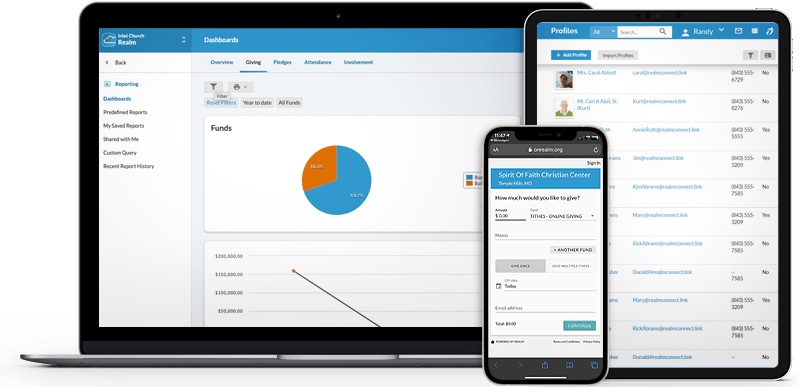
- Built-in fund accounting is genuinely real general-ledger software, not a giving report — rare in the ChMS world.
- Pathways feature lets you build discipleship tracks and actually track members through them.
- Multi-site permissions and cross-campus reporting are mature and battle-tested.
- Background-check integration with Protect My Ministry is built-in for child-volunteer workflows.
- ACS has been doing this for 40+ years; the company won't disappear and your data won't get orphaned.
- UI feels dated compared to Planning Center or Breeze — it's functional, not delightful.
- Implementation usually requires paid onboarding and can take weeks for accounting setup.
- Pricing is quote-based with multi-year contracts; not friendly to month-to-month evaluation.
- Mobile app is competent but lags behind Subsplash or Pushpay for member experience.
- Customizing reports beyond the built-in templates can require ACS support, which adds friction.
Mid-size Presbyterian churches that need fund accounting, session-level permissions, and one durable vendor for membership and finance.
You want a modern, mobile-first interface or transparent month-to-month pricing.
Realm is a serious tool that doesn't get talked about enough in the trendier corners of church tech. If your finance team is your most influential stakeholder — and at most denominational churches over 500 people, they are — Realm's accounting module is a legitimate reason to choose it over Planning Center plus QuickBooks. The cost is that you pay in user experience: the interface, mobile app, and onboarding all feel like they were designed in 2018 and not updated since. We'd consider it a strong, slightly conservative choice for established churches that value durability over polish.
2. Breeze ChMS
Flat-fee, simple ChMS that wins on pricing transparency for small and mid-size churches.
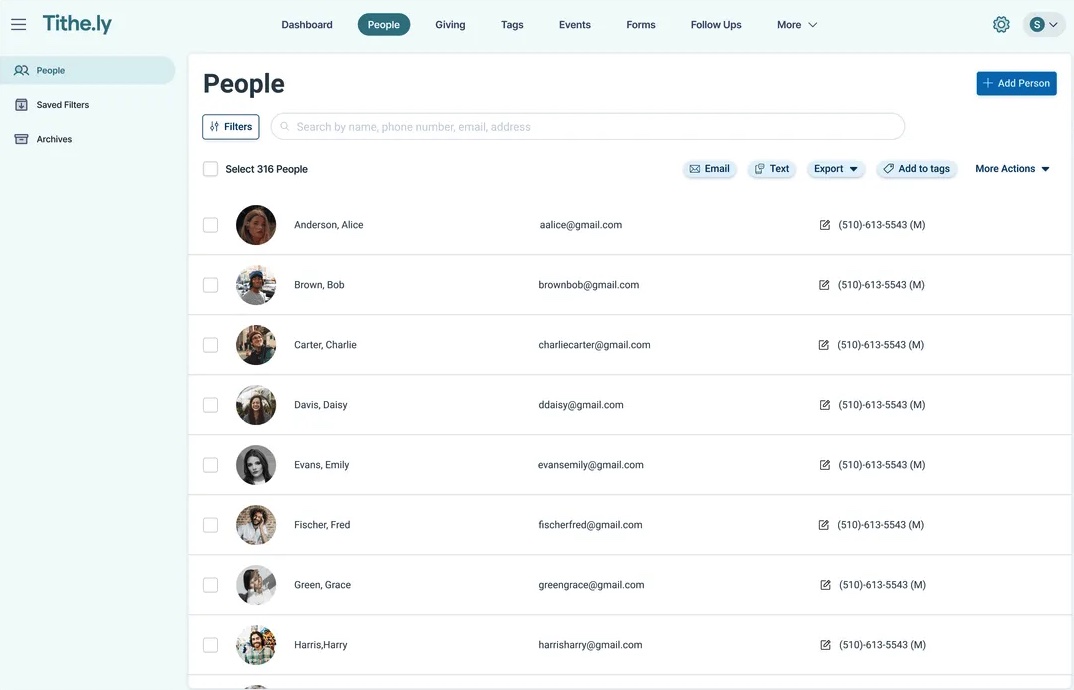
- One flat price means you can plan your budget for the year without worrying about hitting member-count brackets.
- Setup genuinely takes an afternoon; the data import wizard and contextual help are aimed at non-technical office staff.
- Free 1-on-1 onboarding calls are included, which is rare at this price point.
- Tagging system replaces the rigid groups/lists model used by older ChMS and is far more flexible for small staffs.
- Works as well from a Chromebook in a church office as from a phone, with no separate admin app.
- Volunteer scheduling is functional but a tier below Planning Center Services for any church with a band rotation.
- Reporting is shallow; you can't easily slice attendance against giving over a multi-year window without exports.
- No general-ledger accounting; you'll still need QuickBooks or Aplos for finance.
- Acquired by Tithe.ly in 2021 and roadmap velocity has visibly slowed since.
- No website builder and no native live streaming; very much a back-office tool, not a digital front door.
Smaller Presbyterian churches under 400 attendance who want flat pricing and a tool a part-time admin can actually run.
You need real fund accounting inside the same tool or session-level permissioning is a hard requirement.
Breeze is what most small-church administrators actually want: a flat $72/month bill, a database that doesn't fight them, and check-in that works on Sunday morning. It's not the most powerful ChMS — Planning Center will out-feature it on every comparison sheet — but it's the one we'd recommend to a 200-person church without hesitation. The post-acquisition slowdown is the asterisk. Tithe.ly clearly bought Breeze for the customer base, and the product hasn't made a major leap in two years. If you sign up now, you're betting it stays this good rather than gets meaningfully better.
3. Planning Center
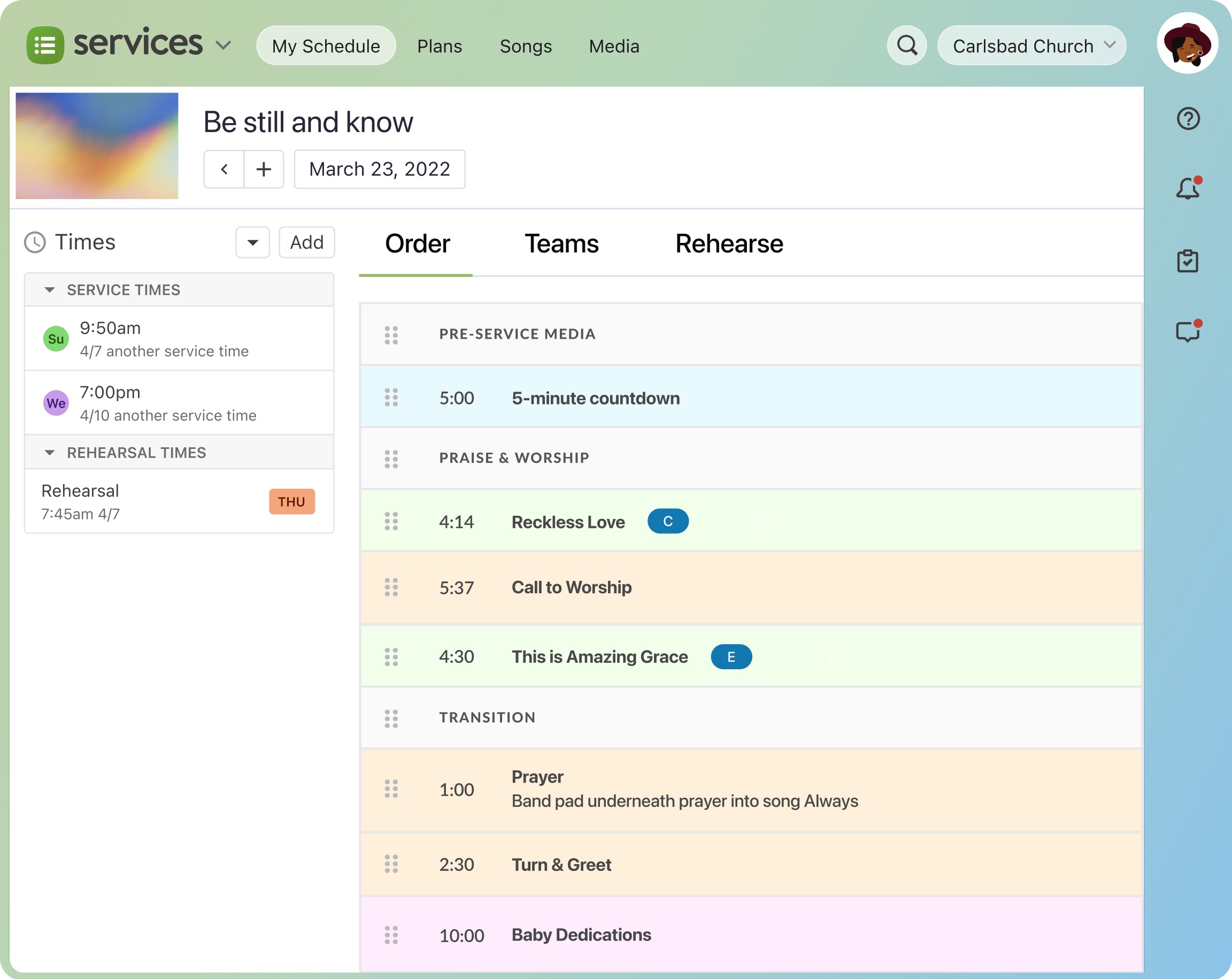
The modular industry standard for service planning, volunteer scheduling, and people management.
- Modular pricing means you only pay for the products you actually use, instead of bundling features you'll never touch.
- Services module is genuinely the gold standard for worship planning, with chord charts, rehearsal recordings, and conflict-aware scheduling.
- Church Center mobile app gives members one polished entry point for giving, groups, events, and check-in.
- Strong API and webhook coverage make it the easiest ChMS to integrate with custom tooling or third-party reporting.
- Onboarding is self-serve and well-documented; most churches go live without a paid implementation contract.
- Costs add up fast once you adopt 4-5 modules; a 500-person church can easily spend $250+/month before processing fees.
- No native general-ledger accounting, so finance teams still need QuickBooks or another system alongside it.
- Reporting across modules is inconsistent; some products have rich filters, others feel like an afterthought.
- The product suite still feels like separate apps stitched together, which means navigating between Services, People, and Giving has friction.
- No website builder, so churches needing a CMS have to pair it with Squarespace, Subsplash, or similar.
Presbyterian churches with active music ministries and multiple weekend services, especially those with a contemporary service.
You need integrated fund accounting or your finance team will not accept QuickBooks alongside.
Planning Center has earned its reputation. Services in particular is the kind of product that ruins you for competitors — once a worship pastor has scheduled bands, sent rehearsal mp3s, and tracked declines from a phone, going back to spreadsheets feels archaic. The trade-off is that PCO has stayed deliberately narrow: no accounting, no website builder, no live streaming. That focus is the reason each module is so good, but it also means you'll be writing checks to two or three other vendors. For churches over ~150 people with a real worship rotation, this is the safe pick. Smaller churches should look at Breeze first.
4. Servant Keeper
Long-running desktop-era membership database now offered as a cloud subscription, beloved by older staff.
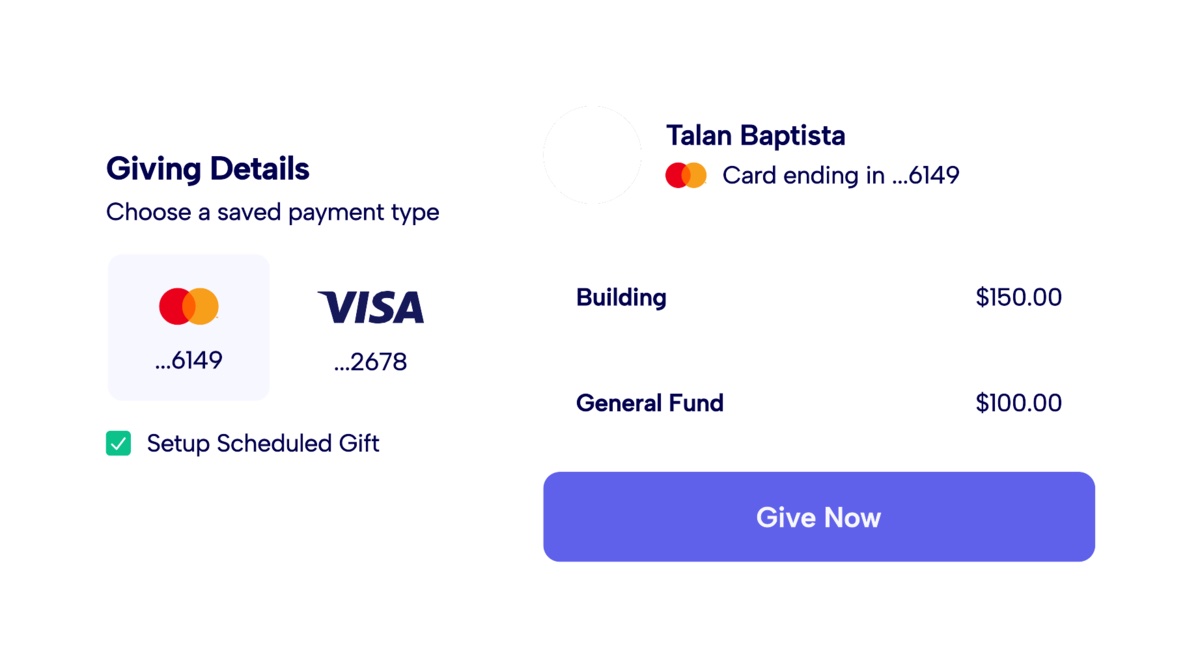
- Contribution tracking and year-end statement generation are mature and trusted by long-time church bookkeepers.
- Still offers a perpetual desktop license, which is genuinely rare and useful for tiny churches without internet reliance.
- Reasonable monthly pricing on the cloud version, and tiering is transparent.
- Customer support reportedly answers the phone and is willing to walk new users through setup.
- Long track record — over 30 years in business — gives confidence the data won't be orphaned by a pivot.
- Interface and workflows clearly originated as desktop software; the cloud version still feels like a port, not a redesign.
- Volunteer scheduling and modern child check-in are essentially missing.
- Mobile app is limited and not a primary way to use the product.
- Integration with modern marketing and communications tools is shallow.
- Difficult to recommend to a younger staff that has used Planning Center or Breeze elsewhere.
Traditional Presbyterian congregations whose long-time clerk or treasurer already knows the desktop product.
Your staff is mobile-first or expects modern SaaS workflows.
Servant Keeper is the answer to a specific question: 'Our 70-year-old bookkeeper has used this for 20 years and refuses to switch.' That's not a knock — that institutional trust is worth real money. But for any church starting fresh in 2026, this is a tool whose ceiling is low. The cloud version is a port of the desktop one, not a reimagining, and the gap with Breeze or ChurchTrac at similar price points has only widened. We respect the longevity. We'd still recommend most readers look elsewhere unless continuity with an existing install matters more than capability.
5. ChurchTrac
Quietly capable, low-cost ChMS with built-in accounting that punches well above its price.
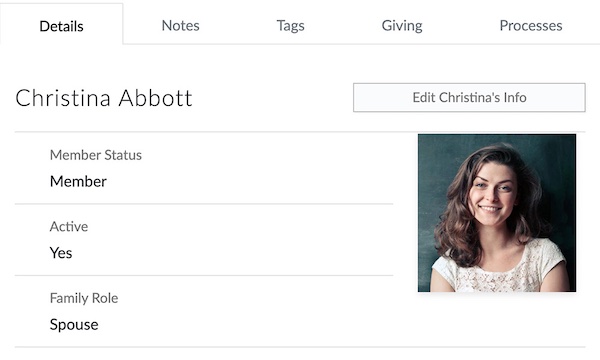
- Pricing is unbeatable for what you get — full ChMS plus fund accounting for under $25/month at most church sizes.
- Genuine built-in fund accounting at the small-church price point is essentially unique to ChurchTrac.
- Free plan is real and not a 14-day trial; small congregations can run it indefinitely.
- Owner-operator company with real responsiveness on email support, not a tiered ticket queue.
- Data is exportable and ownership is clear — no lock-in beyond your monthly subscription.
- UI is utilitarian; it works, but it doesn't have the polish of Breeze or Planning Center.
- Mobile experience is web-based primarily; the dedicated mobile app is functional but limited.
- Volunteer scheduling is basic and won't satisfy a church with a serious worship rotation.
- Brand recognition is low, so peer learning and tutorials are thinner than for category leaders.
- Integration ecosystem is shallow; if you live in Zapier, you'll feel constrained.
Smaller Presbyterian churches who need fund accounting on a tight budget without paying enterprise prices.
Your staff cares about UI polish or you live in an integrations-heavy stack.
ChurchTrac is a sleeper. It doesn't have the marketing budget of Tithe.ly or the polish of Planning Center, but for small churches that genuinely need fund accounting alongside the database, nothing else at this price point exists. We've seen it run perfectly well at 400-person churches with a part-time bookkeeper. The honest caveat is that it looks and feels like the work of a small team — because it is — and if your staff is younger or comes from polished SaaS tools, the UI will feel dated. Trade design for capability and money saved, and you'll come out ahead.
6. Tithe.ly
Aggressively priced giving platform with a growing ChMS, app, and website stack underneath it.
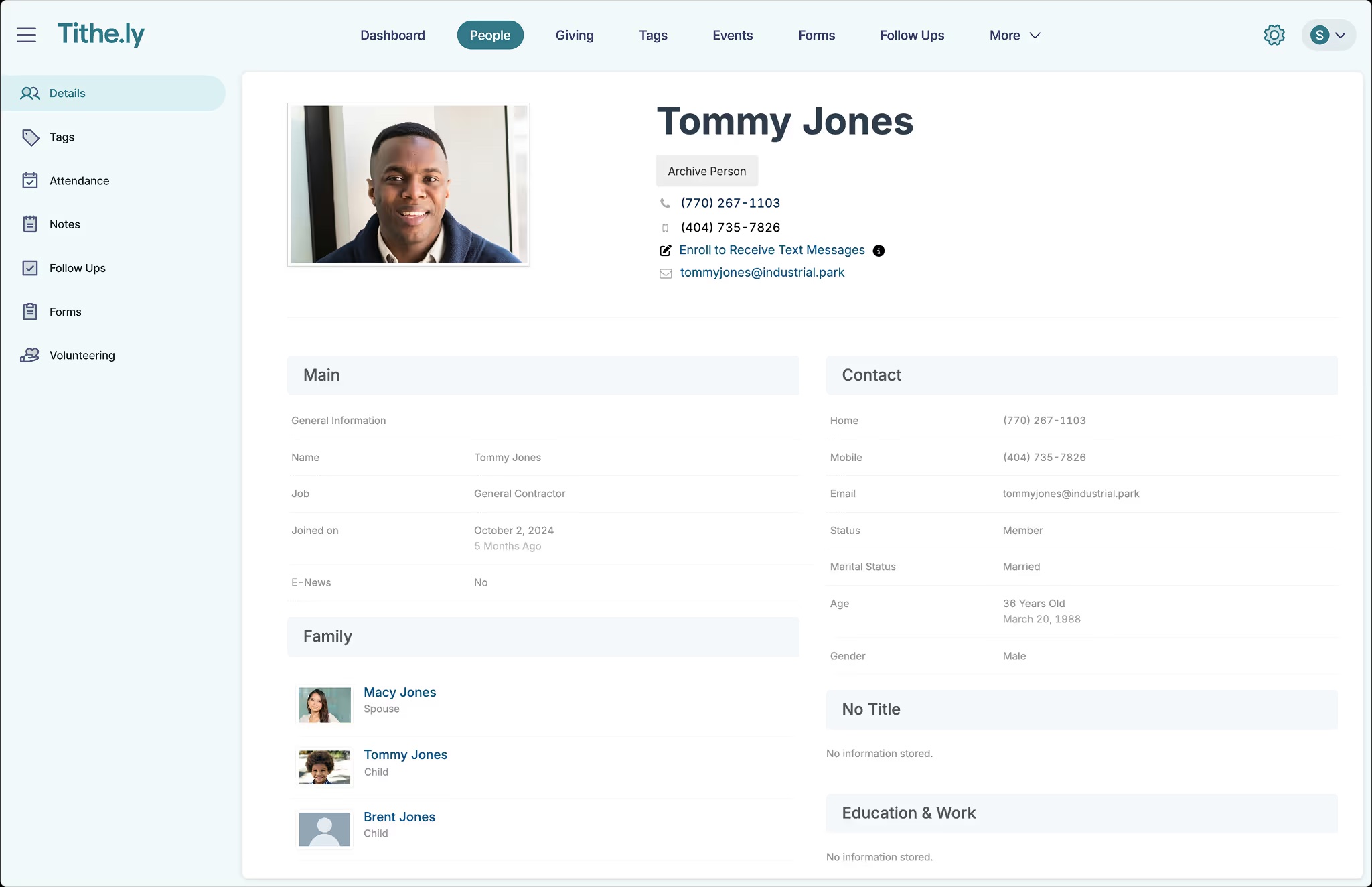
- Free giving plan with no monthly fee genuinely removes the financial barrier for churches launching online giving.
- All-Access bundle is the cheapest path to website + app + giving + ChMS in a single bill.
- Sites builder produces clean, mobile-first church websites without needing a developer.
- Active acquisition strategy (Breeze, Elvanto) means the platform footprint keeps expanding.
- Migrating donors from another platform is smooth — Tithe.ly will actively help move recurring gifts.
- Multiple acquired products under one brand creates a confusing UX; ChMS, Sites, and Giving all feel like different apps.
- Customer support has slipped in 2024-2025 reviews; ticket times stretched to days during peak season.
- Reporting is functional but can't match Pushpay or Planning Center for cohort analysis.
- Volunteer scheduling exists but most churches still use Planning Center Services alongside it.
- Roadmap priorities are unclear — it's hard to tell which acquired product is actually getting investment.
Presbyterian churches that want online giving live tomorrow with no monthly platform fee.
You need integrated reporting across giving and membership in one polished interface.
Tithe.ly's bet on free giving was the right one, and it's how they got footholds in tens of thousands of churches. The harder bet is whether they can stitch Breeze, Elvanto, Sites, and the original Giving app into something that feels like one product. Right now it doesn't — it feels like a holding company. For a 150-person church just trying to take their first online gift, that doesn't matter and you should sign up today. For a 600-person church evaluating an all-in-one, the seams are visible enough that we'd seriously look at Planning Center plus a separate website tool instead.
7. Pushpay (with Church Community Builder)
Enterprise-grade giving and ChMS suite aimed squarely at large multi-campus churches.
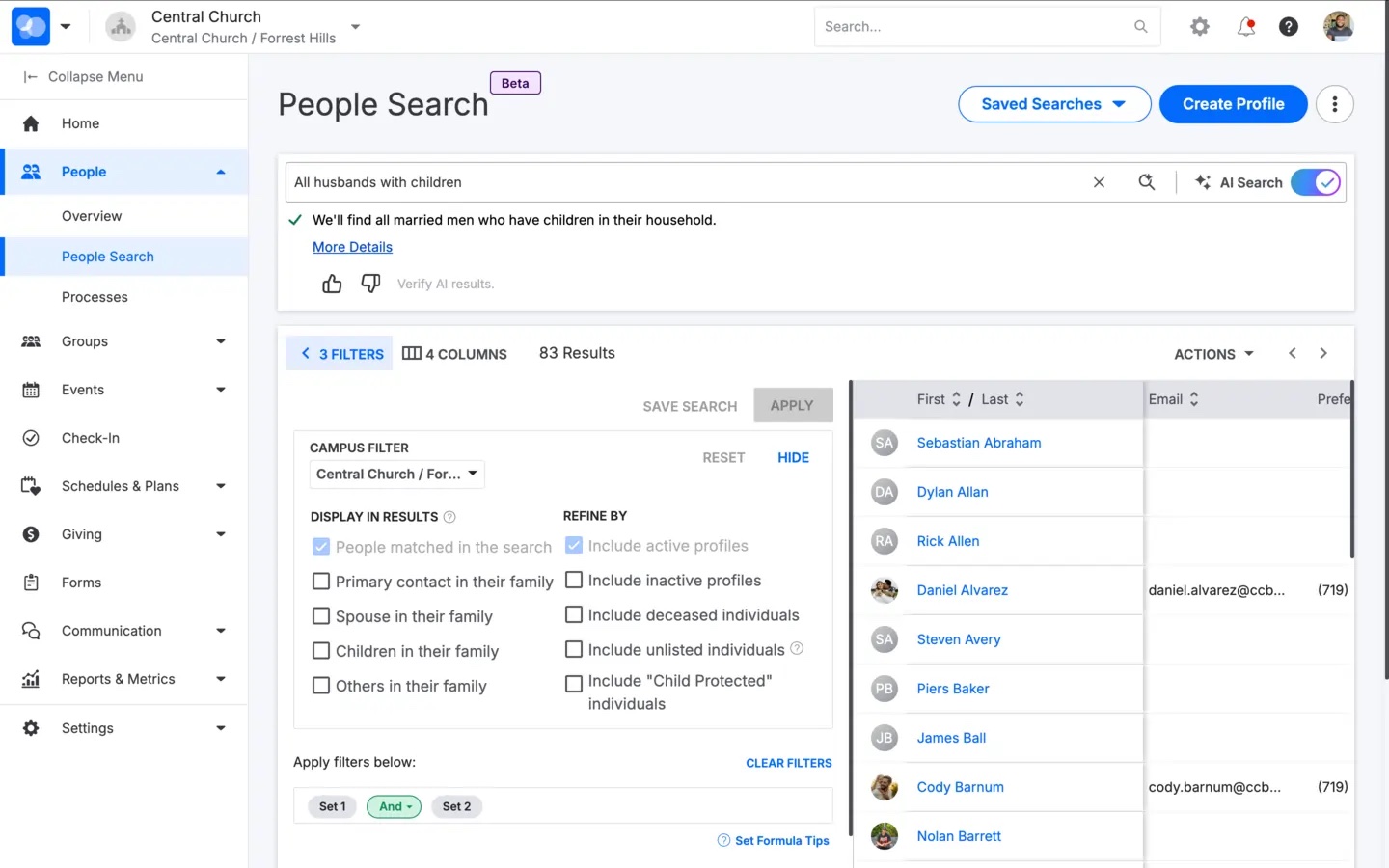
- Donor experience is genuinely best-in-class: text-to-give, recurring setup, and digital wallet flows have very low friction.
- Branded app product is mature and used by many of the largest churches in the US, with solid sermon and live-stream playback.
- Reporting on giving is deep — donor retention cohorts, lapsed-giver flagging, and pledge tracking are first-class.
- Account management is high-touch; your CSM actually knows your campus structure and giving patterns.
- CCB integration lets you tie giving back to small-group attendance and discipleship paths in one record.
- Pricing is opaque and quote-only; smaller churches routinely get pushed out of the funnel by sales gating.
- Transaction fees are higher than Stripe-direct competitors like Tithe.ly or Planning Center Giving.
- Contracts are typically annual and often multi-year, with auto-renewal clauses that catch staff off guard.
- CCB feels like the older product in the pairing; UI hasn't kept pace with Planning Center or newer entrants.
- Switching off Pushpay is meaningfully painful — donor data export and recurring-gift migration both require manual coordination.
Larger Presbyterian churches with seven-figure giving programs that benefit from a high-touch CSM and donor app.
You are under 800 attendance or unwilling to negotiate annual contracts for giving software.
Pushpay is the enterprise pick. If you're a 5,000-person multi-site church, you almost certainly already use it or have considered it, and the reasons are real: the donor app converts, the CSM relationship matters when you're processing seven figures of giving annually, and the CCB pairing covers most of what you need. The catch is that you pay for that polish, and the contract structure makes it hard to leave. We'd push back hard on any church under 500 people who's been pitched this — you're paying for a tier of service you won't use.
Verdict
For mid-size Presbyterian churches with real session governance and presbytery reporting requirements, Realm is the strongest fit¹. ACS Technologies has decades of mainline Presbyterian customers, the fund accounting handles session-designated funds cleanly, and the role-based permissions actually map to elder, deacon, clerk, and pastor cleanly.
For smaller Presbyterian congregations, Breeze plus Tithe.ly Giving is the more honest answer²³. The flat pricing is treasurer-friendly, the tagging system handles the session-deacon-committee structure adequately, and a part-time admin can run it. You will key in your statistical report manually each year, that is true on every platform on this list.
Where we would push back: do not let a Pushpay rep convince you that CCB's session-friendly features justify the contract⁵. They are fine. They are not specifically Presbyterian. The premium is not earned for most churches under 1,000 attendance.
Sources
- Realm by ACS Technologies product pages, accessed 2026-05
- Breeze ChMS pricing page, accessed 2026-05
- Tithe.ly pricing and giving plan, accessed 2026-05
- Planning Center product and Services pages, accessed 2026-05
- Pushpay product and Church Community Builder pages, accessed 2026-05
- Wisefig internal testing notes (hands-on with PCUSA, PCA, EPC, and ECO sessions and clerks)