Breeze ChMS review: is it worth it in 2026?
By Sankalp Jonna · Last reviewed April 2026
Breeze ChMS
Flat-fee, simple ChMS that wins on pricing transparency for small and mid-size churches.
Visit Breeze ChMS ↗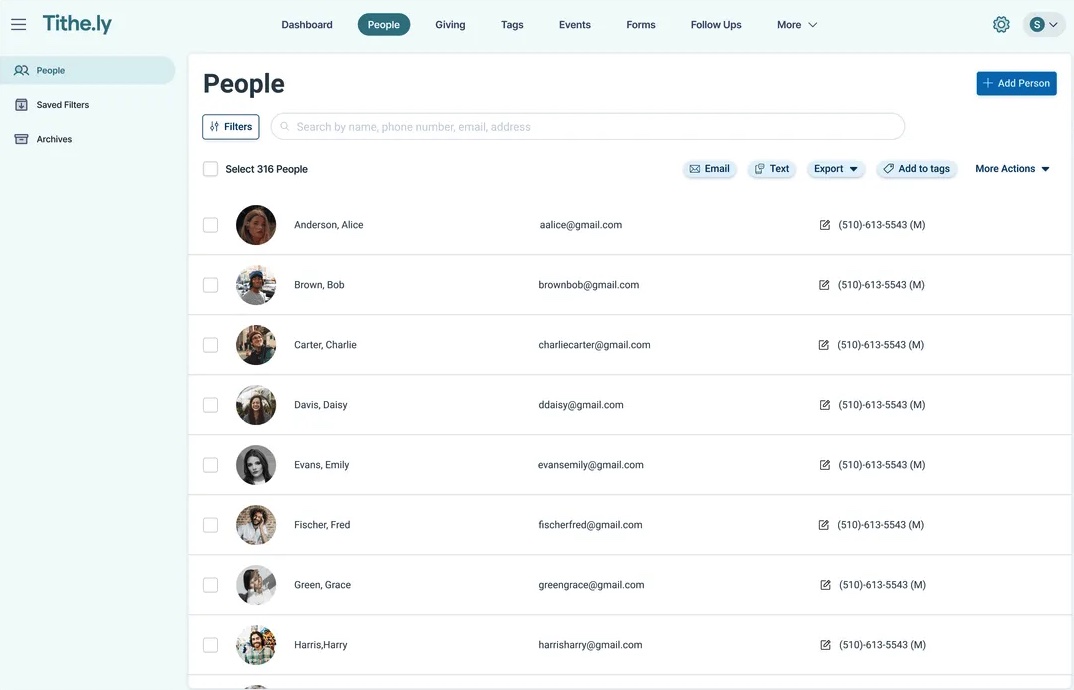
Breeze is the small-church ChMS that won by refusing to play the pricing game. One flat fee. Unlimited people. Unlimited users.¹ The pitch took a category obsessed with per-record tiers and made budget planning a non-event, and that's why a 200-person church can sign up on a Tuesday afternoon and have working check-in by Sunday.
The asterisk we have to keep raising is what happened after Tithe.ly bought it in 2021.² The product still works the way it did at acquisition, which is the good news. It also hasn't moved much since, which is the bad news. Breeze in 2026 is the same Breeze you'd have liked in 2022, and we're recommending it on that basis — knowing you're getting a stable tool, not a fast-moving one.
What it is
Breeze ChMS is a cloud-based church management system founded in 2010 by a small team in Grand Rapids, Michigan, and acquired by Tithe.ly in 2021.² It covers the back-office basics: a member database, contribution tracking with year-end statements, attendance and check-in (including label-printing kids check-in), basic event registration, mass email and SMS, and a simple volunteer scheduler.³
The product's defining design choice is the tagging system instead of rigid groups and lists. You tag a record with whatever attribute matters — first-time guest, choir, allergic to peanuts, finance committee — and every report and email filter pulls from those tags. For a non-technical church secretary used to spreadsheets, this clicks fast.
What Breeze does not do: real fund accounting, a website builder, live streaming, or worship-grade volunteer scheduling. It pairs with QuickBooks for accounting, Squarespace or similar for the website, and Planning Center Services for any church with a real band rotation. As a back-office ChMS, it's complete. As a digital front door, it's not trying to be one.
Who it’s for
Breeze is built for churches between roughly 50 and 600 weekly attendees who want one tool for membership, giving, and check-in without needing a power user on staff. Denominationally agnostic; we see it at Baptist, Methodist, non-denominational, and Anglican churches in roughly equal measure. The buyer is almost always either a senior pastor with no full-time admin, or a part-time church administrator who came from QuickBooks and a paper roster.
It is not the right pick for multi-site churches, churches over about 1,000 weekly attendance, or churches with a serious worship rotation that demands chord charts and rehearsal mp3s. The reporting also won't satisfy a data-driven executive pastor — slicing giving against attendance over a multi-year window means CSV exports. If any of those describe you, look at Planning Center first.
Key features
One price, unlimited people, unlimited users, unlimited storage, unlimited support. About $65/month if paid annually. The simplest pricing in the category and the main reason small churches sign up.
Members are organized by tags, not rigid hierarchies. Every report, email, and filter pulls from the same tag set. Far more flexible for small staffs than the groups-and-lists model used by older ChMS.
Records pledges, recurring gifts, and one-time donations, generates IRS-compliant year-end statements, and integrates with Tithe.ly Giving for online donations. The bookkeeper-friendly part of Breeze.
Label-printing kids check-in with security codes that runs on a browser-based station. Holds up under the volume of a 600-person Sunday without special hardware.
Every new account gets a real person on a setup call. Rare at this price point, and a meaningful reason non-technical staff actually go live instead of stalling out mid-import.
Build event signup pages with paid or free registration, capacity limits, and waivers. Functional, not flashy, but covers the use case for retreats, VBS, and small-group sign-ups.
Online giving runs on Tithe.ly's processor at 2.5% + $0.30 for cards and 1% for ACH. The integration is tight, though the underlying processor is the standard Tithe.ly stack you'd get standalone.
Pros & cons
- One flat price means you can plan your budget for the year without worrying about hitting member-count brackets.
- Setup genuinely takes an afternoon; the data import wizard and contextual help are aimed at non-technical office staff.
- Free 1-on-1 onboarding calls are included, which is rare at this price point.
- Tagging system replaces the rigid groups/lists model used by older ChMS and is far more flexible for small staffs.
- Works as well from a Chromebook in a church office as from a phone, with no separate admin app.
- Volunteer scheduling is functional but a tier below Planning Center Services for any church with a band rotation.
- Reporting is shallow; you can't easily slice attendance against giving over a multi-year window without exports.
- No general-ledger accounting; you'll still need QuickBooks or Aplos for finance.
- Acquired by Tithe.ly in 2021 and roadmap velocity has visibly slowed since.
- No website builder and no native live streaming; very much a back-office tool, not a digital front door.
Pricing
Breeze is one of the only churches-management tools where pricing is a single number on the homepage. Standard plan is $72/month with everything included; pay annually and it drops to roughly $65/month.¹ There are no people-count tiers, no upsell modules, no 'enterprise' line item. What you sign up for at 100 people is what you pay at 600.
The honesty here is genuine, but the trade-off is that there's no cheaper plan for very small churches. A 40-person plant pays the same $72 as a 500-person established church, which can feel steep when ChurchTrac's free plan covers up to 100 people. Breeze's pitch is that the value scales with growth — and it does — but if budget pressure is real and you're under 100 people, it isn't always the cheapest option even though it's the simplest.
| Plan | Price | Includes |
|---|---|---|
| Standard | $72/month | Flat $72/month for unlimited people, users, storage, and support. No tiered upcharge. |
| Annual | $65/month | Roughly $65/mo when paid annually; same feature set as monthly. |
Transaction fees: 2.5% + $0.30 (credit) / 1% (ACH) on Breeze Giving
Alternatives
The modular industry standard for service planning, volunteer scheduling, and people management.
Quietly capable, low-cost ChMS with built-in accounting that punches well above its price.
Aggressively priced giving platform with a growing ChMS, app, and website stack underneath it.
Verdict
We'd recommend Breeze for almost any church between 75 and 500 people whose primary problem is 'we need a database and check-in that works without a fight.' The flat pricing genuinely makes budgeting trivial, the tagging system is the right model for small staffs, and the Sunday-morning check-in holds up.⁴ For a church administrator who has been wrestling with spreadsheets, Breeze is the upgrade that pays for itself in time saved.
Where we hesitate is the post-acquisition trajectory. Tithe.ly bought Breeze for the customer base and the product hasn't seen a major leap since. If you're choosing a ChMS to live in for the next five years, you're betting that 'good and stable' stays good rather than that the roadmap accelerates. For most small churches, that bet is fine — the things Breeze does well are the things you need it to keep doing well. For growing churches expecting to cross 800 or 1,000 in the next two years, Planning Center is the safer long-horizon pick.
Sources
- Breeze ChMS pricing page, accessed 2026-05
- Breeze ChMS company and acquisition history
- Breeze ChMS product features overview
- Wisefig internal testing notes (hands-on)